
Introduction
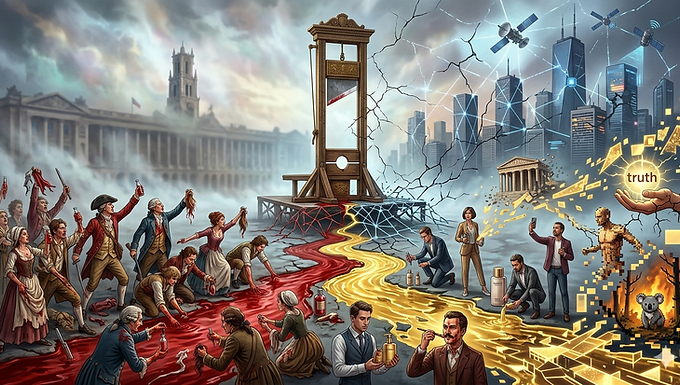
Every epoch is known by what it deems impossible to desecrate.
For the medieval man, this limit was the body of Christ, whose sacred inviolability permeated the entire edifice of the social — from the oath of fealty to the peasant’s vow sworn upon a relic.
For classical liberalism of the nineteenth century — the dignity of the autonomous subject, whose freedom of will was thought to be natural and inalienable.
For the modernist avant-garde — the right to a rupture with tradition, to a gesture without precedent.
We, however, looking back upon the first quarter of the new millennium, are compelled to acknowledge: the horizon of the sacred has shifted into a zone previously guarded by silence.
What was desecrated yesterday had seemed, only the day before, the unshakable foundation of reality itself. Death has ceased to be taboo — it has become content. Truth has ceased to be a correspondence with fact — it has become a function of coherent narrative. Man has ceased to be the measure of all things — he has become raw material, a project, a point of application for optimizing forces.
But every act of desecration is simultaneously an act of revelation — an unveiling of what was previously concealed beneath the veil of reverent rhetoric. When a prohibition falls, a structure is exposed. This book is an attempt to scrutinise those ruptures that have formed in the place of fallen prohibitions. We have named them *hacks* — not accidentally. In this word, something more resounds than mere “event” or “incident.” A hack is always an intrusion, a violation of a boundary, access to what was kept behind seven seals. A hack of reality exposes its password — that hidden code by which it had hitherto been operating.
And there is one hack that sets the tone for all subsequent ones. One moment in which, as in a drop of blood, the entire tectonics of the coming two centuries is reflected. That morning of 21 January 1793 on the Place de la Révolution in Paris.
Historians still dispute the air temperature that morning (approximately three degrees above zero) and the density of the fog that enveloped the route from the Temple to the scaffold. But the principal question concerns what exactly happened at 10:22 a.m., when the blade of the guillotine severed the head of Louis Capet from his body (Die Welt, 2020).
From a formal-legal standpoint, everything was in order. The National Convention, after a multi-stage vote, condemned the former monarch to death for high treason by a majority of a single vote. Maximilien Robespierre, the chief ideologue of this decision, formulated the aphorism that became the manifesto of the new power: “Louis must die because the Fatherland must live” (Novaya Yunost, 2015). From the standpoint of political pragmatism — an iron logic: as long as the king lives, so does the alternative to the republic.
But the matter lay neither in juridical nor in political logic. The matter lay in what happened *after* the blade fell.
A German witness by the name of Elsner, whose records are cited by the historian Ernst Schulin (quoted in Die Welt, 2020), left an account from which the contemporary reader’s skin still freezes. The crowd did not merely exult — it staged a “disgusting orgy.” People dipped their fingers in the executed man’s blood, drew moustaches on themselves with his blood, smeared their sabres in royal blood, filled their scabbards with it. Louis’s clothing was torn into tiny shreds — each person wanted to carry home a piece of fabric soaked in the blood of the Lord’s anointed. Locks of his hair were later sold for enormous sums (Die Welt, 2020).
Elsner, a man of the Enlightenment, is at a loss for explanation: “I do not know whether this was connected with the extraordinary nature of the event, or whether the cause lay simply in some kind of political superstition” (quoted in Die Welt, 2020).
He did not know — but we do. Or, at least, we can surmise, thanks to those who, a century and a half after this execution, deciphered its authentic meaning.
In 1924, the French historian Marc Bloch, future founder of the *Annales* school and future member of the Resistance executed by the Gestapo in 1944, published a book that initially seemed a marginal excursion into the realm of medieval superstitions. It was called *The Royal Touch* (Bloch, 1973).
Bloch investigated a phenomenon that existed in England and France for eight centuries: the belief that the king could heal scrofulous patients by his touch. Thousands of people flocked to monarchs so that they might lay their hands upon them. This belief was not the result of coercion or deceit — it formed part of a deep-seated “collective mentality,” as Bloch’s students would later say. People truly believed that the king’s body possessed a particular, sacred power (Bloch, 1973, pp. 124–156).
Just over thirty years later, in 1957, the German-American historian Ernst Kantorowicz, who had fled the Nazis to Princeton, provided a theoretical grounding for this belief. His book *The King’s Two Bodies* became one of the principal works of twentieth-century political theology (Kantorowicz, 2016).
Kantorowicz demonstrated that medieval and Renaissance jurisprudence had created an astonishing fiction: the king possesses two bodies. One is the natural body, like that of all men — subject to illness, passions, old age, and death. But there is also another — the political body, which never dies. It is “a corporation concentrated in one man,” whose members are all the subjects. As the English legal formula of the sixteenth century states: “Over this body, passion and death have no power — as regards this body, the king does not die” (Kantorowicz, 2016, pp. 23–45).
This is precisely why, upon the burial of one monarch, the next is immediately proclaimed: “The king is dead, long live the king!” — the natural body dies, but the political body is immortal and instantly passes to the heir.
What, then, happened on 21 January 1793?
The executioner Charles Henri Sanson cut off the head of the natural body of Louis Capet, the former king. But at that very moment, something unprecedented occurred: the political body of the king was annihilated along with the physical one. It was not transmitted to his heir — the Dauphin, languishing in the Temple. It was not transferred to a new institution. It was annihilated.
The blood with which the revolutionaries smeared their faces and sabres was not merely the blood of a man. It was the blood of a sacred being that had, for a thousand years, held together the social cosmos of France. And when that blood spattered onto the wooden boards of the scaffold, and then onto the faces of those who held out their hands to receive it — something more than monarchy departed from the world along with it.
Marc Bloch, describing the belief in the miraculous power of kings, called it a “collective error” (Bloch, 1973, p. 412). Kantorowicz, more cautious, spoke of “political theology” — a way of thinking power as the presence of the eternal within the temporal (Kantorowicz, 2016, p. 506).
But for us, looking back at this scene from the twenty-first century, something else is more important: that blood on the faces of the Parisians was the first blood of an epoch in which we are still living. An epoch in which the sacred can not merely be dethroned but literally trampled, torn apart into souvenirs, turned into a commodity and into bloody paint for moustaches.
It is precisely this operation — the reduction of the sacred to the level of expendable material, raw matter, an object of manipulation — that we shall trace through the pages of this book.
The hack perpetrated by the guillotine on 21 January 1793 was not reducible to a change of political regime. It was an ontological hack — a breach into another dimension of reality, after which the old categories ceased to function.
Here is how one might describe the shift that took place.
Before the execution, there existed a conception of two bodies — the natural and the political, the mortal and the immortal. This conception ensured the continuity of time and the stability of social space. One could hate a particular king, one could rebel against him, but the very figure of the King as a principle remained inviolable. The sacred was localised, personified, and thereby — limited, but also protected.
After the execution, it transpired that the political body is as mortal as the natural one. Moreover: it can be killed, and the killing is not merely a physical act but a symbolic, performative act that institutes a new reality. Robespierre was right in one respect: the death of Louis was necessary for the nation to be born. But he did not foresee another consequence: having killed the political body of the king, the revolution unleashed a process that did not stop at monarchy.
In the following two centuries, it would transpire that one can kill the political body of God (Nietzsche announced this philosophically, while the Gulag and the Holocaust did so practically), the political body of Man (liberal humanism would collapse under the blows of totalitarian ideologies), the political body of Truth (postmodernism would deconstruct any claim to objectivity).
The blood of Louis XVI became the seed from which the forest of subsequent desacralisations grew.
But this book is not about the eighteenth century. It is about how the same mechanisms operate today — in our immediate, breathing-down-our-neck contemporaneity.
The design of *The Awakening* is at once simple and complex. We take specific events of recent years — those very “hacks” that breach the fabric of habitual reality — and examine them as diagnostic instruments. Each such event is like a drop of reagent on the litmus paper of an epoch: it reveals those structures that usually remain invisible.
We do not aspire to exhaustive coverage. Our task is different: to create an atlas of fault lines. A map of those points where the old philosophical categories — ontology, epistemology, ethics, anthropology, social philosophy — fail, cease to grasp reality.
The reader will find here chapters devoted to the most diverse phenomena: from the hallucinations of artificial intelligence to the euthanasia of koalas after the Australian bushfires; from the privatisation of Venice by billionaires to the collapse of the FTX crypto-empire; from the Epstein case, which exposed the impunity of elites, to Ozempic, which has turned the human body into a pharmacological project. Each of these episodes is treated not as “news” but as a philosophical symptom — evidence of deep tectonic shifts that are changing the very structure of our presence in the world.
We are not interested in journalism. We do not care who is right or wrong in a given conflict. What matters to us is something else: what reality does this conflict expose? Which assumptions, once thought unshakable, collapse at the point of the hack? What new questions arise for thought, compelled to operate under conditions where old answers no longer work?
A necessary warning is required here.
This book is a prequel. It precedes another text, more systematic and more complex. Its task is not to offer ready-made solutions, but to sharpen perception. To bring the reader into a state that might be called “productive perplexity”: when the old explanatory schemes have collapsed, but new ones have not yet been constructed.
We deliberately do not introduce — or scarcely introduce — here the conceptual apparatus developed in the treatise Tristasis. We do not speak of the three principles of being, of diaphoretics as a method, or of onto-engineering as a practice. All of this will remain in the background — for now.
Here, we are only making a diagnosis. We are showing that the world in which we live has not merely “changed” or “become more complex.” It has become ontologically problematic. The categories bequeathed to us by Plato and Aristotle, by Descartes and Kant, by Hegel and Heidegger, by analytic philosophy and poststructuralism — all of them, taken separately, fail when confronted with a reality where the machine hallucinates truth, where the body becomes a function of biochemistry, where the past is privatised and the future is sold in instalments.
A new language is needed.
A new optics.
A new way of thinking complexity.
But before offering answers, it is necessary to sharpen the questions to their utmost edge. This is the purpose of *The Awakening*.
The structure of the book follows the logic of a philosophical investigation.
In the first part, we turn to what has always constituted the core of philosophy — questions of reality and truth. The hacks perpetrated by artificial intelligence and quantum physics compel us to reconsider the very concept of “existence.”
The second part is devoted to anthropology and ethics. Who is man, if his desires are produced pharmacologically? What is freedom, if its highest manifestation can be the voluntary renunciation of freedom? How is ethics to be constructed if the “I” is permeable and vulnerable?
The third part examines mutations of the social. Power, Capital, and Culture appear here not as institutions but as archetypal forces that have acquired autonomy and subjugated man to themselves. The Epstein case, the NFT boom, the privatisation of Venice, the censorship of Christmas symbolism — all these are symptoms of a single malady: the dissolution of a common world into the private universes of elites.
The fourth part leads us to limits — ecological and existential. The death of the koalas, which became the euthanasia of an entire species; the crisis of scientific expertise, exposed by the boycott of a Nobel laureate; the impossibility of thinking nature otherwise than as a resource — these episodes bring us to the very edge, beyond which lies either the abyss or… something else.
We begin each chapter with a concrete scene. This is a matter of principle. We are not constructing abstract speculations — we are scrutinising the flesh of the event. It is important to us that the reader see that very moment of the hack: the frame, the smell, the gesture, the slip of the tongue, the number. And only then, starting from this sensory givenness, do we ascend to the levels of philosophical reflection.
We quote extensively. The reader will find references in the text to Marc Bloch and Ernst Kantorowicz, to Michel Foucault and Pierre Bourdieu, to Hannah Arendt and Giorgio Agamben, to a whole range of contemporary thinkers. The complete bibliographical apparatus is given at the end. But quotations for us are not ornamentation nor a means of proving our erudition. They are instruments of diagnosis. We invoke the classics not because they provided final answers, but because they taught us how to pose questions correctly. And today, these questions sound more acute than ever.
In the book about the execution of Louis XVI, one of the witnesses left an account that haunts me. He describes how people, having scooped royal blood into their palms, “later sold very dearly” locks of his hair (Die Welt, 2020).
In this gesture lies the entire dialectic of modernity. The sacred is not merely destroyed — it is *converted*. Into a commodity, into a souvenir, into an object for collecting, into an instrument of identity. The king’s blood becomes a liquid asset before it has even dried on the scaffold’s boards.
We today live in a world where this conversion has become total. Anything can be turned into anything else.
Death — into content.
Love — into a subscription.
Truth — into an algorithmic hallucination.
The body — into an optimisation project.
The past — into a tourist decoration.
The future — into a startup.
And the question that stands behind every analysis in this book is this: what remains inconvertible?
What resists translation into a format, a price, information, a simulacrum?
Where is the boundary beyond which the hack becomes irreversible, and reality — definitively lost?
We do not know the answer. More precisely: we know that the answer cannot be given in ready-made form — it can only be suffered through in the process of thinking, only assembled from the fragments of shattered categories. It is to this — the assembly of a new optics — that the following treatise is devoted. But for now…
For now — welcome to The Awakening. To a world where the old gods are dead, the new ones are not yet born, and the blood on the faces has long ceased to be royal — it is one’s own, intimate, flowing from countless wounds that we inflict upon ourselves in the attempt to wake up.