
3.3. Democracy Is Watching You
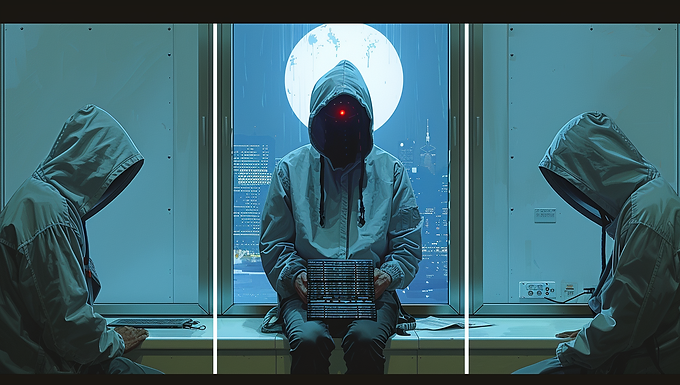
Hack: June 2013, Hong Kong, Mira Hotel
In a hotel room in Hong Kong, three people meet. Two of them are journalists known for their investigative work: Glenn Greenwald, a columnist for The Guardian, and documentary filmmaker Laura Poitras, already experienced with dangerous subjects. The third is a young man with a pale face and an agitated demeanor, who calls himself Veronica. He has brought hard drives whose contents, within days, will explode across the planet's information space.
Edward Snowden, a 29-year-old systems administrator who worked as a contractor for the U.S. National Security Agency (NSA), hands over tens of thousands of documents to the journalists. These documents reveal the scale of global surveillance conducted by U.S. intelligence agencies, not only against potential adversaries but also against their own citizens, against allies, and against all of humanity.
The documents, subsequently published by The Guardian, The Washington Post, and other outlets, paint a picture that leaves advocates of liberal democracy breathless. The PRISM program grants intelligence agencies direct access to the servers of Google, Facebook, Apple, Microsoft, Yahoo—to all emails, photos, files, and messages passing through the world's largest internet platforms. The XKeyscore program allows for the analysis of virtually all traffic on the global network. The Tempora program, implemented by the British Government Communications Headquarters (GCHQ), intercepts the fiber-optic cables carrying information between continents.
But perhaps the most striking aspect is not the technical power of the revealed systems, but the reaction to the disclosures. U.S. President Barack Obama, who had received the Nobel Peace Prize just a few years prior, justifies the surveillance programs as necessary for protecting national security. Director of National Intelligence James Clapper states that the publication of the documents inflicts irreparable damage on the country. Snowden is charged with espionage and theft of government property.
The hunt begins. Snowden, stranded in the transit zone of Moscow's Sheremetyevo Airport, spends over a month there—a no-man's land, a space of legal vacuum where he exists literally between worlds. Russia grants him temporary asylum; the U.S. demands extradition. European leaders, outraged that their communications were intercepted, express solidarity, but nothing more.
At the heart of this conflict lies a simple question, upon which our understanding of the nature of modern power depends: Does the state have the right to collect information on all its citizens without exception, in the name of their own security? And if so, where is the boundary beyond which security transforms into total control, and the protection of citizens into their annihilation as political subjects?
From the Panopticon to the Synopticon and Beyond
To adequately grasp the philosophical significance of the events surrounding the Snowden revelations, they must be placed within the broader context of the evolution of social control mechanisms, the theoretical understanding of which began long before the advent of digital technologies.
The classic model, invariably invoked by researchers in surveillance studies, was developed by Jeremy Bentham in the late 18th century and received its most famous theoretical elaboration in the work of Michel Foucault. This is the panopticon—an architectural structure enabling a single observer to see all inmates while remaining unseen themselves. The fundamental characteristic of this model is that inmates never know if they are being watched at any given moment, but they know that observation could occur at any time. This engenders an effect Foucault termed "unconscious discipline": individuals begin to regulate their own behavior, internalizing power and making it part of their own psychic structure.
For Foucault, the panopticon becomes a model for how power functions in the disciplinary societies of the 18th and 19th centuries. This is a power that isolates, normalizes, and corrects. It operates through enclosed institutions—prisons, barracks, hospitals, factories, schools. Its goal is the production of "docile bodies" suited for the industrial economy and bourgeois order.
The Snowden revelations demonstrate that this model has undergone fundamental changes. First, surveillance is no longer local but global. The networks of the NSA and GCHQ span the entire world—encompassing not only suspected terrorists but also ordinary citizens, heads of state, and international organizations. The panopticon is no longer bounded by prison walls; its walls are the planet itself.
Second, surveillance is no longer exclusively a state function but has become a state-corporate enterprise. As Shoshana Zuboff showed in her seminal work The Age of Surveillance Capitalism (2019), programs like PRISM are based on the deep integration of intelligence agencies and private technology companies. Google, Facebook, and Microsoft do not merely provide data upon request—they built their business models on collecting this data, on transforming human experience into "behavioral surplus," which is then sold on markets predicting future behavior.
Third, the very nature of the object of surveillance has changed. Foucault (1995) wrote of disciplinary power shaping bodies. Zuboff (2019) shows that the new power shapes not bodies, but souls—in the most literal, behaviorist sense. By collecting data on every movement, every click, every search query, every location change, algorithms learn to predict our behavior with such accuracy that they can not only anticipate our actions but also modify them. "The aim of this enterprise," Zuboff writes, "is not to impose behavioral norms, but to produce behavior that yields desired commercial results."
Thomas Mathiesen, in the 1980s, proposed supplementing the panoptic model with that of the synopticon—a situation where the many observe the few (stars, celebrities, public figures). In the age of social media, the synopticon and panopticon merge: we watch celebrities, while surveillance systems watch us. This creates a closed circle of mutual observation from which escape is impossible, because the very desire to participate in social life presupposes leaving digital traces.
Gilles Deleuze (1992), developing Foucault's insight, proposed a distinction between "disciplinary societies" and "societies of control." While disciplinary societies operated through enclosed spaces (prison, school, factory) through which the individual sequentially passed, societies of control function through a continuous, open, distributed mechanism. Control no longer requires isolation; it is embedded in the very structure of everyday life. And it is precisely this model that we observe in the systems revealed by Snowden: control without borders, without exceptions, without respite.
Sovereignty and Exception
Understanding the deeper meaning of these events requires engaging with the conceptual apparatus developed by Giorgio Agamben in his Homo Sacer project. Agamben, drawing on Carl Schmitt and Michel Foucault, introduces the concept of the state of exception—a situation where law is suspended in the name of protecting the law itself, where the sovereign decides on the state of emergency, and this emergency becomes the norm.
In the classic model of sovereignty, traceable to Hobbes, the sovereign is the one who holds the monopoly on legitimate violence, who protects citizens from external enemies and internal conflicts. This protection requires information: to protect, one must know from whom to protect and who needs protection. But information gathered in the name of protection itself becomes an instrument of power.
Agamben shows that in the 20th century, the state of exception transformed from a temporary emergency measure into a stable paradigm of governance. The concentration camp, for Agamben, is not an anomaly but the "nomos" of modernity—a space where law is suspended and life is reduced to bare life (nuda vita), pure biological existence devoid of political status (Agamben, 1998).
The Snowden revelations allow us to see a new form of this process. Digital surveillance creates a virtual space of exception in which we all find ourselves in the position of bare life. Our data is collected without our consent, analyzed without our knowledge, used to predict and modify our behavior. We are not prisoners in the traditional sense—we are free, we move, we communicate. But each step leaves a digital trace, and these traces belong not to us, but to those who collect them.
What occurs here can be called "ontological expropriation." To be is to leave traces. But these traces no longer belong to the one who left them. They become raw material, a resource, capital. The subject is deprived not only of privacy but of the very possibility of controlling their own identity, for identity is now produced by algorithms based on data the subject does not control.
Researchers Lina Dencik, Arne Hintz, and Jonathan Cable (Dencik et al., 2016), analyzing the consequences of the Snowden revelations, introduce the concept of "data justice." They demonstrate that traditional approaches to privacy protection (encryption, technical solutions, legal regulation) are insufficient because they fail to grasp the main point: data collection has become a form of governance, a new biopolitics that redefines the very relationship between the individual and power.
Foucault (2003), introducing the concept of biopolitics, characterized it with the formula "make live and let die." Unlike the classic sovereign power that held the right to "let live and make die," biopower takes life under its care, manages it, optimizes it. Population health, birth rates, mortality, hygiene—all become objects of political management.
In the digital age, biopolitics acquires a new dimension. It is no longer merely about physical health, but about the "health" of data—its completeness, accuracy, relevance. The state and corporations are interested in maximizing data completeness, ensuring that no fragment of human experience escapes digitization. This is a new form of "making live"—making people live in digital space, leave traces, produce information.
But this biopolitics also has a dark side, which Achille Mbembe termed "necropolitics"—the politics of death (Mbembe, 2003). Those who refuse to leave traces, who use encryption, who try to preserve privacy, automatically fall into the category of the suspicious. Refusing participation in the data economy is a form of social death—exclusion from the space of normal communication, normal consumption, normal life.
Snowden, stranded in the transit zone of Sheremetyevo, became a living symbol of this new condition. No-man's land between states, between jurisdictions, between legal systems—a space of pure exception. He could not return to the U.S. (where he faced trial for espionage), could not move freely (his passport was revoked), could not be sure of his safety (intelligence agencies from various countries took interest in him). Literally and metaphorically, he found himself "between"—in that very interval that lays bare the structure of modern power.
The Kierkegaardian theme, taken up by contemporary biopolitics scholars, acquires new resonance here: "large numbers," statistics, probabilistic thinking become tools for pacifying humanity, lulling its vigilance . People voluntarily surrender their data because they are promised convenience, personalization, security. They fail to notice that this convenience is paid for with the alienation of their own subjectivity.
The Crisis of Privacy
Privacy has traditionally been conceived in legal categories. Since the classic article by Warren and Brandeis, "The Right to Privacy" (1890), privacy has been understood as "the right to be let alone." This is a negative right—the right not to be subjected to intrusion, not to be the object of unwanted attention.
The Snowden revelations demonstrate the insufficiency of this legal paradigm. Privacy has ceased to be merely a right; it has become an ontological category, a question concerning the very mode of the subject's existence in the world.
When every action, every movement, every utterance is recorded and stored, when this data can be used at any moment against the subject or simply to manage their behavior, the subject ceases to exist as an autonomous unit. They become a node in a data network, a point of intersection for information flows, an object of algorithmic operations.
Hannah Arendt (1973) in The Origins of Totalitarianism showed that the destruction of the human being begins with the destruction of their legal status, then their moral person, and finally their unique individuality. Digital surveillance does not destroy individuality—it redefines it. Individuality is now not what the subject thinks and says about themselves, but what algorithms can predict about them.
Roberto Esposito, developing the Foucauldian tradition, introduces the concept of "immunization"—the protection of life through its limitation (Esposito, 2008). The paradox of the immune system is that it protects the organism, but excessive protection leads to autoimmune diseases, where the organism attacks itself. Applied to politics, this means: protecting citizens through total surveillance destroys what makes citizens citizens—their autonomy, their capacity for political action, their privacy as a condition of freedom.
In this context, the profound ambiguity of the reaction to the Snowden revelations becomes clear. Many were outraged, but few fundamentally changed their behavior. People continue using Google, Facebook, Instagram, knowing their data is collected. This is not necessarily evidence of weak will or conformism. It may be a sign that there is no alternative. Abandoning digital platforms means abandoning social life, communication, participation in the modern world. There is no choice—only the illusion of choice between different platforms, all of which collect data alike.
The Algorithm as Sovereign
Carl Schmitt defined the sovereign as he who decides on the state of exception (Schmitt, 2005). This decision cannot be derived from the existing legal order, but itself establishes order. The sovereign stands on the boundary between law and lawlessness, norm and exception.
In the systems revealed by Snowden, we witness the emergence of a new type of sovereign—the algorithmic sovereign. Decisions are made not by people, but by algorithms trained on data sets. These decisions are not subject to appeal, because they are not the result of anyone's will that could be contested. They are merely calculations, merely mathematics, merely logic.
Blockchain and cryptocurrencies, discussed in the previous chapter, represented an attempt to create an alternative sovereign—decentralized, algorithmic, non-human. But surveillance systems create a sovereign of a different type—centralized, opaque, yet also algorithmic. Here, code does not liberate, as crypto-anarchists hoped, but enslaves, and enslaves all the more effectively for being invisible.
Shoshana Zuboff calls this new regime "instrumentarianism." Unlike totalitarianism, which operates through violence, instrumentarianism operates through behavior modification. It does not need to force people to do things against their will; it suffices to make them want to do what the system requires. This is power without domination, control without coercion, governance without a subject.
It was precisely this danger that Snowden attempted to convey to the world, risking his own freedom. He showed that the infrastructure is already built, the algorithms are already running, the data is already being collected. We live inside a machine of our own creation, but over which we have already lost control. The question is not how to destroy this machine (impossible without simultaneously destroying modern civilization). The question is how to regain at least partial control, how to restore at least minimal autonomy within a total surveillance system.
From Sovereignty over Territory to Sovereignty over Data
Classical political thought, from Hobbes to Schmitt, was thought about territory. Sovereignty was exercised over land, over borders, over populations living within a defined territory. Wars were fought over territories, treaties concluded about borders, power measured by control over space.
The Snowden revelations signal a fundamental shift: sovereignty is increasingly less tied to territory and increasingly tied to data. Whoever controls the data controls reality, regardless of the physical territory where that data is stored.
This creates a new geopolitical situation. American corporations collect data worldwide. American intelligence agencies have access to it. European leaders, protesting the tapping of their phones, are powerless to change anything because their communications pass through American servers. China, understanding this danger, builds its own internet segment, separate from the global network. Europe attempts to create its own regulation (GDPR), but this does not solve the problem, as data continues to leak.
Snowden, in his Moscow exile, became a symbol of this new world. A man without territory, suspended between states, existing only through the data he revealed. His fate is a metaphor for our common fate in an era where the old categories of the political have ceased to function, and new ones have yet to be formed.
The Snowden affair exposes a fundamental structure that usually remains in the shadows of classical political philosophy: the conflict between visibility and invisibility as a constitutive condition of the modern political order.
Within this conflict, a fundamental tension always exists. The tension between Taxis—order striving for total visibility, complete knowledge of each individual, transparency as a condition of security and efficiency. And Chthysis—the force resisting this total visibility, escaping algorithms, preserving the right to invisibility, secrecy, privacy.
Snowden, by revealing the NSA's secrets, made the invisible visible. He showed that the machine exists, that it operates, that it collects data on everyone. But this is insufficient. Making visible is only to pose the question. The answer to this question requires not merely knowledge, but action; not merely exposure, but politics.
Snowden in his Hong Kong hotel room, handing journalists hard drives full of secrets—an image that will remain in history as a reminder that even under conditions of total control, the possibility of choice remains. A risky choice, perhaps doomed to failure, but a choice nonetheless. And it is precisely this possibility—the last thing preserving the human in the human when all data is collected, all algorithms trained, all futures already predicted.