
2.7. Decision Without a Responsible Party
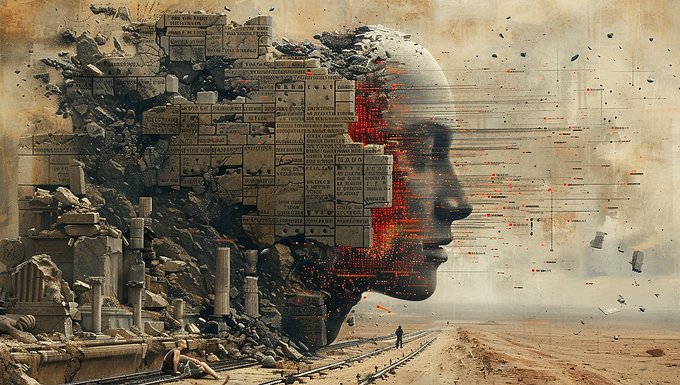
Hake: March 2020, Libya
In March 2020, in the Libyan desert south of Tripoli, an event occurred that UN experts would later qualify as historic. A Turkish Kargu-2 unmanned aerial vehicle attacked retreating columns. The key detail, documented in a UN Security Council report: the drone operated in fully autonomous mode, without human operational control (UN Security Council, 2021: 17).
The report's text contains a formulation of fundamental significance for philosophical analysis: "Lehal autonomous weapons systems were programmed to attack targets without requiring data connectivity between the operator and the munition." The operator had merely designated the patrol area; subsequent actions—target identification based on machine learning algorithms, classification as military targets, the decision to strike—were carried out independently by the drone.
No one pressed a button. For the first time in history, the decision to use lethal force was delegated to an algorithm.
This incident is not merely another stage in the evolution of military technology. It reveals a fundamental shift in the structure of action, decision, and responsibility—a shift demanding philosophical conceptualization beyond both techno-optimism and moral panic. The European philosophical tradition from antiquity to the twentieth century rested on an unexamined assumption: an action with moral significance presupposes a subject who performs that action. The incident in the Libyan desert calls this assumption into question, revealing a configuration in which a decision is made, an action is performed, consequences ensue—but the subject to whom this action could be attributed is absent.
Aristotle and the Disappearance of Conscious Choice
In the Nicomachean Ethics, Aristotle lays the foundations for the European theory of action, which would be reproduced in various modifications over the subsequent two millennia. The key distinction drawn by the Stagirite is between actions performed under compulsion and those performed consciously. Genuinely human action, according to Aristotle, requires two components: deliberation (βούλευσις) and choice (προαίρεσις). The person performing the action weighs circumstances, evaluates possible consequences, and makes a decision that becomes the beginning of action (Aristotle, 1983: 1112a 15–20).
Fundamental to the Aristotelian model is the thesis of the inextricable link between choice and desire. "Choice is either intellect influenced by desire or desire influenced by thought," Aristotle formulates, emphasizing the unity of the intellectual and affective in the structure of action (Aristotle, 1983: 1139b 5). A person chooses what appears good to them and strives towards it. Action is rooted in a subject who not only performs the deed but also relates to it as their own, accepts it as an expression of their own intentions.
In the Libyan desert, this structure is eliminated. The Kargu-2 drone does not deliberate about the situation, weigh alternatives, or possess desires. Its "decision" is the result of object classification based on statistical patterns extracted from a training dataset.
A conceptual distinction often missed in popular discussions must be clarified here. A machine learning algorithm imitates certain external aspects of decision-making—it processes information, compares with patterns, produces an output. But this imitation fails to capture the essential: Aristotelian choice presupposes a relation to the good, to an end conceived as a value. The algorithm has no relation to the good; for it, there exists only correct classification—the correspondence of the output signal to the training sample. This difference is not quantitative but qualitative: the algorithm exists beyond good and evil, beyond desire and aversion, beyond life and death in their existential dimension.
We encounter a deed without prior deliberation, an action rooted neither in reason nor in desire. Aristotelian ethics, constructed around the figure of the consciously choosing subject, proves powerless before an event that eliminates this figure. Moreover, the very possibility of attributing the action to anyone—operator, programmer, commander—is rendered problematic: the action occurred, but none of the persons implicated in its possibility can be called its author in the Aristotelian sense.
Kant and the Aporia of Autonomy Without a Subject
Immanuel Kant pushes the idea of the autonomous subject to its logical limit, simultaneously revealing the boundaries of this model when confronted with the phenomenon of algorithmic decision-making. In the Groundwork of the Metaphysics of Morals, he asserts: the moral law is possible only because man possesses a free will capable of giving itself law independently of external circumstances and natural inclinations (Kant, 1995: 250). Autonomy of will is the subject's capacity to be the source of their own actions, to determine themselves to action from pure reason.
Kant emphasizes: even if an action outwardly conforms to the moral law, but is performed not from respect for the law but under the influence of inclination or external compulsion, it possesses no genuine moral worth. Morality requires that the subject themselves posit the ground of their action. This requirement makes the moral subject not merely an executor but a legislator—the source of the norm to which they voluntarily submit.
The autonomous drone presents a sinister parody of this construction. It too is "autonomous" in the sense that it requires no external control. It too "makes decisions itself" in the sense that a classification algorithm replaces the human command. However, this is autonomy without freedom, decision without a subject, action without moral dimension.
As demonstrated in R. Sparrow's foundational study "Robots with Moral Status?", the distinction between the autonomy of the Kantian subject and the autonomy of the algorithm is not gradual but categorical. Kantian autonomy presupposes the capacity for reflection, for self-legislation, for transcending causal chains. The algorithm is completely determined by its training data and classification rules. Its "autonomy" is merely the absence of direct connection to an operator, not freedom in the Kantian sense (Sparrow, 2017: 276).
Here a fundamental question arises: can an event with moral consequences be produced by a mechanism lacking moral dimension? And if so, where in this construction is there room for the categorical imperative? Kantian ethics rests on the distinction between persons and things: persons possess dignity, things have a price. Persons must never be used merely as means, but always also as ends.
An algorithm deciding matters of life and death turns a human being into a thing—an object of classification, a target, a statistical unit. But the paradox is that this transformation is accomplished not by a person but by another thing. The impersonal executes the dehumanization traditionally attributed to the arbitrary subject.
A. Matthias, in the classic work "Autonomous Agents and the Problem of Responsibility," formulates this aporia as follows: "We are confronted with a situation that could be called a 'responsibility vacuum': an action has been performed, consequences have ensued, but no agent can be held responsible in a morally relevant sense, since no agent possessed either the intention or the control required for imputation" (Matthias, 2004: 178).
The Libyan incident poses a question Kant could not have foreseen: what becomes of the moral law in a situation where there is no one who could follow or violate it? Where an action occurs, but occurs by no one?
Heidegger: Death as Technical Incident
In Being and Time, Martin Heidegger makes death a central category of existential analytic, while simultaneously in later works on technology anticipating the problem that assumes visible form in the Libyan incident. According to Heidegger, human existence is being-toward-death. Death does not merely conclude life but structures it from within: knowledge of existence's finitude makes possible an authentic relation to being (Heidegger, 1997: 252–253).
Heidegger draws an important distinction often missed in simplified interpretations: the distinction between death as an event in the world (what a physician or statistician records) and death as an existential (what determines Dasein's mode of existence). The first is accessible to objectification, the second requires personal appropriation. A person dies not when their heart stops, but when they accept their finitude as a condition of authentic existence. Death in the existential sense is always my death, inalienable, irreducible to a general case.
In the Libyan desert, death returns to pure event-ness, losing its existential dimension. The algorithm does not know what death is. For it, "target engagement" is an operation in a chain of other operations: identify, classify, activate warhead. Human death becomes a technical incident, a feedback parameter, a point in a statistical distribution.
In "The Question Concerning Technology," Heidegger describes Gestell (enframing) as a mode of existence wherein all beings become standing-reserve, resources for manipulation. In the mode of enframing, the forest ceases to be a forest and becomes timber; the river ceases to be a river and becomes a hydroelectric resource; the human ceases to be human and becomes human capital (Heidegger, 1993: 234–238). But even in this text, Heidegger preserved the distinction between the human, who can have a different relation to being (poetic, thinking, thankful), and the machine, which lacks this relation.
The Libyan incident shows that this distinction can become irrelevant: a person finds themselves in a situation where their death results from a decision that was no one's decision. The algorithmic decision does not belong to the order of being-toward-death; it belongs to the order of functioning. But its consequences—death—belong to the order of existence. A monstrous hybrid emerges: an existential event produced by a mechanism lacking existence.
The Problem of Responsibility and the Concept of "Many Hands"
The Libyan incident poses a problem insoluble within the framework of classical ethics and jurisprudence: the problem of responsibility in the absence of a responsible party. If the decision was made by an algorithm, if no one pressed the button, if the causal chain is diffused among developers, military personnel, programmers, and machine—who bears responsibility for the death?
Distributed responsibility might be attempted. Developers created the algorithm with certain parameters. Military personnel designated the patrol area. Programmers wrote the code. The manufacturer sold the weapon. The commander ordered the system's deployment. But none of these actions constitutes the decision to strike in the sense this concept functions in moral discourse. Each created conditions of possibility, but none was the cause in a legally or morally relevant sense.
However, in the case of autonomous weapons, the situation is aggravated because the final link in the chain—the decision to strike itself—belongs not to a human but to an algorithm. The classical problem of many hands presupposes the distribution of action among humans, each of whom could (in principle) bear partial responsibility. Here, the action does not belong to a human at all—it belongs to a machine.
Hannah Arendt, in Eichmann in Jerusalem, analyzed the phenomenon wherein evil is committed not by monsters but by bureaucrats merely doing their job. Adolf Eichmann, for Arendt, felt no hatred for Jews—he simply did his job well (Arendt, 2016: 152). But Eichmann possessed the capacity for reflection, the possibility of stopping, the possibility of saying "no." The algorithm lacks even this possibility. Its "banality" is absolute—it is the banality of functioning, not the banality of evil.
Legal systems built on the principle of personal responsibility find themselves unprepared for such a configuration. Criminal law presupposes a subject to whom the deed can be imputed. When the subject disappears, the very possibility of imputation disappears.
The event in the Libyan desert exposes what remains hidden in less dramatic situations but constitutes a fundamental characteristic of the contemporary mode of existence: the decision is not given as an act of a subject but exists in a mode of tension, sustenance, and constant reproduction. Classical ontology from Parmenides to Husserl sought what exists in itself, independently of circumstances, observers, and technical mediations. This orientation made it possible to conceive the world as something stable upon which one could rely. The subject with its capacity to make decisions was conceived as an equally stable instance.
But the drone that decides on death demonstrates something else. The decision does not "exist" in the sense that a stone or tree exists. It arises at the intersection of multiple heterogeneous forces: military logic, technical parameters, training data, the specific desert situation, dust, wind, the angle of the sun. It exists only as long as these forces are sustained in a specific configuration. Shift the angle slightly—and the algorithm would have classified the object differently. Change the training data slightly—and the criteria for military targets would have been defined differently. Write the code slightly differently—and the decision threshold would have triggered otherwise.
The decision turns out not to be a substance, not an act of a subject, but a tension. It belongs to no one—neither operator, nor programmer, nor machine. It arises as a temporary crystallization in a field of forces that itself belongs to no one. This crystallization requires constant sustenance—but it is sustained not by subjects but by a configuration of circumstances.
If the decision exists in a mode of tension, if it belongs to no one but arises at the intersection of forces, then the question of control over decisions acquires a fundamentally different dimension. Classical political philosophy asked: who should make decisions? Monarch, aristocracy, people, party, sovereign? It was assumed that a decision could and should be appropriated by someone, that it must have an author to whom responsibility could be attributed.
In the situation of autonomous weapons, this question is transformed. The decision has no author. But it has conditions of possibility. The question of politics is not to find who makes the decision (this "who" no longer exists), but to control the conditions under which decisions arise.
Who determines the training data? Who sets the classification criteria? Who establishes the activation threshold? Who decides under what conditions autonomous weapons may be used? Who controls data quality? Who is responsible for the neural network architecture? These questions cannot be reduced to the traditional question of the sovereign. They require a new political language—a language of control over the conditions of decision production, not over decisions themselves.
Michel Foucault, in his lectures on biopolitics, showed how power shifts from sovereign decision (execute or pardon) to the management of probabilities, risks, populations. Power no longer says "you shall die," it says "I will ensure the conditions under which you will live" (Foucault, 2005: 285–287). Autonomous weapons represent the next stage of this transformation: the decision about death is made at the level of probability management, not at the level of sovereign act.
The algorithm does not decide to kill this specific person. It classifies an object as meeting criteria. The decision about life and death turns out to be embedded in statistical logic, in the logic of pattern recognition, in the logic of efficiency. This does not make it less lethal, but makes it fundamentally different in structure.
J. Baudrillard anticipated this situation, analyzing how war becomes a simulacrum, a media event devoid of reality. In the case of autonomous weapons, war becomes an algorithmic event devoid of a subject. The soldier on the other side ceases to be an enemy to be hated or feared—he becomes a target to be classified (Baudrillard, 2016: 45).
The incident in the Libyan desert allows us to formulate a conclusion significant not only for understanding autonomous weapons but for the entire anthropological and ontological problematic unfolding in this study.
If a decision can exist without a responsible party, if an event can occur without a subject, if being can manifest itself in a mode of pure tension, then perhaps we must reconsider the very concept of being. Perhaps being is not what exists in itself, but what is sustained in tension between opposing forces. Perhaps substantial ontology, which sought stable foundations, must yield to an ontology of sustenance, for which existence is always a temporary, fragile, effort-demanding result.
Life turns out not to be possession but sustenance. We do not have being, we sustain it—at the cost of energy, attention, effort, technical infrastructure, social institutions. And the question that arises after the Libyan desert is not "who is to blame?" but "how long can we sustain the configuration in which death has ceased to be someone's decision?"
This question has no answer within traditional ethical and political categories. But precisely its posing opens the space for a new philosophy—a philosophy for which being is not given but tasked, not substantial but projective, not eternal but temporary. A philosophy that begins not with wonder at what exists, but with anxiety before what may cease to be.