
2.2. Two Thousand Corpses and Silence
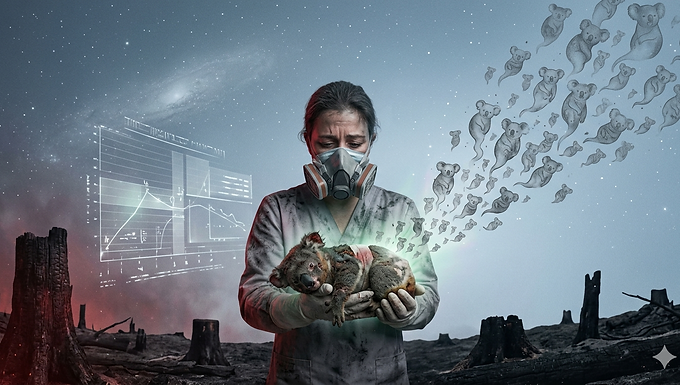
Hack: January 2020, Australia, Kangaroo Island
During the summer of 2019–2020, Australia experienced unprecedented bushfires, which entered history as the "Black Summer." According to final assessments by scientists, the fires destroyed more than 18 million hectares of territory, including key habitats of endemic species (WWF, 2020). The total number of vertebrate animals killed is estimated at approximately three billion individuals.
Koala populations suffered particularly severe damage. Slow-moving, possessing a narrow dietary specialisation (feeding exclusively on eucalyptus leaves), they proved highly vulnerable to rapidly spreading fire. According to various estimates, between 30 and 40% of the population of this species perished in the worst-affected regions (van Eeden et al., 2020).
However, the most philosophically significant aspect of the tragedy was not the number of animals killed per se, but the decision taken regarding the survivors. A significant proportion of koalas rescued from the fire had suffered such severe burns and injuries that their long-term survival proved impossible — both because of physical damage and because of the complete destruction of the habitat necessary for their food base. Under these conditions, veterinary services and conservation organisations decided on the mass euthanasia of the doomed animals.
This decision, dictated by considerations of humanity and the practical impossibility of rescue, nevertheless marks a fundamental shift in the human relation to nature. We have moved from the position of "guardian" or "protector" to a position in which we are compelled to decide on the termination of life of those very beings we failed to protect. This is not killing out of cruelty, nor sacrifice in the name of higher ends. It is killing born of powerlessness — and it is precisely this aspect that requires philosophical reflection.
The euthanasia of individual animals in veterinary practice is a routine procedure. When an individual animal suffers from an incurable disease or injury, the decision to euthanise is made on the basis of compassion for a particular being.
The Australian case is qualitatively different. The decision was made not regarding individual animals but regarding a class of individuals — those meeting certain criteria of injury severity and lacking prospects of survival in a destroyed environment. The animal ceases to be a unique suffering being and becomes a statistical unit in a population model.
Here we encounter what Michel Foucault called "biopolitics" — a form of power that governs not individuals but populations, life as such (Foucault, 2008). Biopolitics operates with categories of birth rate, mortality, morbidity — statistical regularities, not individual fates.
In the Australian case, biopolitics reaches its limit. The issue is not the governance of life but the governance of death — which lives are worthy of continuation and which are not. The criterion is not right, not the moral value of an individual being, but resources and biological prospects.
Giorgio Agamben, developing the Foucauldian intuition, introduced the concept of "bare life" — life stripped of political status, reduced to pure biological existence (Agamben, 1998). Koalas after the fires are bare life in the most literal sense. They have no future, no environment, no chance of survival. Their life is pure suffering, and it is precisely for this reason that it can be terminated "in the name of mercy."
The Crisis of Anthropocentric Ethics
The entire Western ethical tradition, from Aristotle to Levinas, was constructed around the human being as the sole or primary subject of morality. Nature and animals were considered either as means for human ends or as objects of moral concern, but not as subjects possessing their own dignity.
Aristotle, in the Politics, formulates this position with extreme clarity: "Plants exist for the sake of animals, and animals for the sake of man" (Aristotle, 1984: 15-20). Nature is a resource, material, means. The human being is the end.
The Christian tradition softens this anthropocentrism by introducing the concept of the "creature" as a creation of God, possessing value not only in the eyes of man but also in the eyes of the Creator. Yet here too, the human being remains at the centre: the world was created for man; man is the crown of creation.
Early modern philosophy inherited this anthropocentric orientation. René Descartes regarded animals as complex automata, lacking not only reason but also the capacity for suffering in the full sense (Descartes, 1989). Immanuel Kant, softening this position, nevertheless maintained that animals are not rational beings and may therefore be used as means: "With regard to the beautiful but non-rational being, we have no immediate duties" (Kant, 1998: 412).
The twentieth century brought attempts to expand the moral circle. Albert Schweitzer formulated the principle of "reverence for life": "I am life that wills to live, in the midst of life that wills to live" (Schweitzer, 1969: 45). Peter Singer, drawing on the utilitarian tradition, argued for animal rights on the basis of their capacity to suffer (Singer, 1975). Ecophilosophy demanded recognition of the value of ecosystems, not merely of individual beings.
Yet even in these radical versions of environmental ethics, one fundamental intuition remained intact: the human being remains the subject of decision. It is the human being who determines the boundaries of the moral circle, who weighs interests, who decides what is valuable and what is not. Nature may be the object of care, but not the subject of choice.
The Australian fires and the subsequent euthanasia of koalas expose the limit of this paradigm. The human being finds himself in a position where he cannot protect — he can only kill. Our ethics is no longer an ethics of protecting life but an ethics of governing death.
The suffering of animals has always been a problem for theological thought. If God is omnipotent and benevolent, why do innocent creatures suffer? This problem, known as theodicy, received its classical formulation in the works of Leibniz, who attempted to justify God in the face of worldly evil (Leibniz, 1985).
Voltaire, in his Poem on the Lisbon Disaster, subjected theodicy to devastating critique, pointing out that the suffering of the innocent cannot be justified by any "harmony of the whole" (Voltaire, 1984). The Lisbon earthquake of 1755, which claimed thousands of lives, became an empirical refutation of optimistic metaphysics.
Yet an earthquake is a natural catastrophe, independent of human beings. The suffering of animals in the Australian fires is structured differently. Climate change, which greatly intensified the intensity and scale of the fires, is the result of anthropogenic activity. The destruction of habitat is a consequence of human expansion. The decision on euthanasia is a human decision.
Here we encounter a problem that can be called anthropodicy: the justification of the human being in the face of suffering for which he is directly or indirectly responsible. If theodicy attempted to justify God, then anthropodicy attempts to justify the human being. And if theodicy ultimately failed (we cannot justify the suffering of the innocent by any "higher harmony"), then anthropodicy faces even more serious difficulties.
We cannot justify the suffering of animals either by reference to the natural order (the order has been disrupted by us) or by appeal to higher ends (the ends are ours; animals are not participants in their attainment). We stand before suffering for which we are responsible, and the only thing we can offer is death.
Three billion animals. Ten thousand koalas in one region alone. Numbers of this magnitude pose a problem that can be called epistemic: how can we comprehend suffering of such magnitude?
Theodor Adorno, in a famous aphorism, wrote: "To write poetry after Auschwitz is barbaric" (Adorno, 2003: 52). This aphorism captures not so much a prohibition on poetry as the impossibility of an aesthetic appropriation of the experience of mass destruction. Experience of such magnitude does not fit into traditional forms of representation, cannot be translated into individual experience.
A similar problem arises with regard to the mass death of animals. We can mourn one koala — a video of a rescued animal being bottle-fed evokes empathy and a desire to help. But ten thousand koalas — that is statistics. A figure in a report. Our psyche is incapable of containing the suffering of ten thousand individual beings.
This phenomenon has not only psychological but also philosophical dimensions. The capacity for empathy, as research has shown, has limits, and these limits are set not by moral principles but by cognitive mechanisms (Singer, 2009). We cannot empathise with statistics — we can empathise only with the individual.
The euthanasia of thousands of koalas became possible precisely because the decision was made at the statistical, not the individual, level. No one made a decision about the death of a specific koala — the decision was made about a class of individuals meeting certain criteria. The animal ceased to be a "face" and became a "case."
The most difficult aspect of the Australian tragedy to comprehend is the motivation for euthanasia. The animals were not killed out of cruelty, nor out of economic gain, nor out of political considerations. They were killed out of mercy.
This presents us with a paradox that does not fit into traditional ethical categories. Mercy is a virtue, presupposing compassion for the sufferer and a willingness to alleviate their condition. But here the alleviation of suffering takes the form of the termination of life itself.
Peter Singer, a consistent utilitarian, sees no paradox here. If an animal's life is pure suffering without prospect of improvement, then the termination of that life is an ethically justified act (Singer, 1975). Suffering has negative value, and its cessation is a good, whether achieved by cure or by death.
Yet this utilitarian logic leaves unanswered the question of who, and on what basis, decides on the "hopelessness" of a life. In the case of the Australian koalas, the decision was made by humans — the very humans whose activity (directly or indirectly) created the conditions that made the animals' lives impossible.
Here we encounter what can be called the hermeneutic circle of guilt and mercy. We are guilty of creating the conditions of suffering. And it is precisely this guilt that makes us "legitimate" executioners — those who decide on the cessation of suffering through the cessation of life. Mercy turns out to be inseparable from guilt, and the act of mercy becomes an act of final destruction of those we failed to protect.
Bioethics and Biopower
The phenomenon of mass animal euthanasia requires interpretation in the categories of bioethics and biopolitics. Michel Foucault showed how modern power is transformed from the power of the sovereign, who has the right to kill, into a power that takes life under its tutelage (Foucault, 2008). Biopower is power that governs birth rates, mortality, health, hygiene — everything that constitutes the life of the population.
Yet biopower also has a reverse side — the power to dispose of death. Foucault called this "racism" in a specific sense — a mechanism that allows a distinction to be drawn between lives worthy of continuation and lives that may be terminated in the name of the health of the whole.
The Australian fires expose this mechanism in its pure form. The state and conservation organisations decide which lives are worthy of preservation and which are not. The criterion is not the individual value of each being but biological prospects and available resources.
This decision is made not in the name of political ends but in the name of "humanity." Yet it is precisely this appeal to humanity that makes it particularly difficult to criticise. How can one object to an act performed out of compassion?
Giorgio Agamben, developing the Foucauldian intuition, introduced the concept of the "state of exception" — a zone where law is suspended and life becomes "bare," accessible to unlimited violence (Agamben, 1998). The Australian koalas found themselves in such a state of exception — not for political reasons but for ecological ones. Their life had lost political and moral significance and become pure biological fact. And it was precisely for this reason that it could be terminated "in the name of mercy."
The Australian tragedy raises questions to which we have no ready answers. What does it mean to be responsible for a life you cannot save? What does it mean to decide on the death of those you have doomed to perish? How is ethics possible under conditions where mercy and killing become indistinguishable?
These questions take us beyond the limits of classical anthropocentric ethics. We can no longer think of the human being as the "crown of creation" or the "guardian of nature." We are a factor determining the conditions of existence of millions of other species, and this factor often operates blindly and destructively.
Posthumanist thought, developed by authors such as Donna Haraway and Rosi Braidotti, proposes a rethinking of the relations between the human being and nature in categories of mutual dependence and becoming-together (Haraway, 2016; Braidotti, 2013). We are not above nature nor outside nature — we are inside complex ecological networks, where every action has consequences that cannot be fully predicted or controlled.
The Australian fires show that this interdependence can take tragic forms. Our action (or inaction) creates conditions in which other species are doomed to perish. And the only thing we can offer them is death free of suffering.
This is neither justification nor consolation. It is a diagnosis: we have entered an era when the traditional categories of ethics — good, evil, justice, mercy — malfunction. They were created for a world where the human being was the protagonist and nature the background. Today, nature has ceased to be the background and has become both participant and victim at the same time.
The Australian tragedy exposes the structure that in classical ethics usually remains in the shadows: the conflict between life and death not as a metaphysical opposition but as a practical dilemma of decision-making.
In this conflict, there is always tension. Tension between individual suffering and population prospects. Tension between mercy as compassion and mercy as killing.
This tension is irresolvable. It cannot be "sublated" by a final decision — neither by total protection of any life (which would lead to even greater suffering) nor by cynical acceptance of death as the norm (which would mean the abandonment of the very idea of ethics).
It can only be held — in a mode of constant renegotiation of boundaries, constant taking of responsible decisions, constant awareness of the tragic nature of any choice.
Ten thousand koalas killed out of mercy — a reminder that the stakes in this conflict are higher than we are accustomed to think. It is not merely a matter of moral principles or environmental policy. It is a matter of the very possibility of ethics in a world where the human being has become the principal force determining the life and death of other species. And where the only answer to the question "what must we do?" often turns out to be: "We do not know, but we must decide."
Perhaps the tragedy of the koalas indicates not a crisis of humanity but a deeper shift. We are no longer in the space of moral decisions. We are in the space of the technical administration of life. The decision on euthanasia is neither "good" nor "evil." It is an operation of resource distribution, population regulation, adjustment of the biological field.
And in this sense, contemporary power acts not as judge nor as executioner, but as an operator of the environment. We no longer choose between life and death. We manage the densities of existence. It is precisely here, perhaps, that the necessity of a different ontology arises — one in which life is understood not as a sacred essence but as a fragile imprint on a deeper medium, always subject to erasure.