
1.5 The River That Became "I"
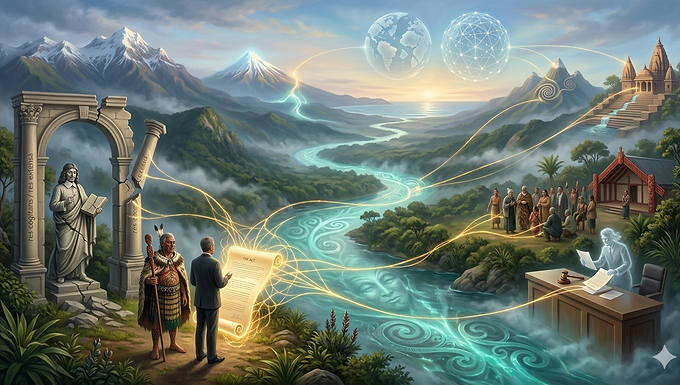
The Hack: Transformation of the Legal Status of Natural Objects, 2017–2025
On 15 March 2017, the Parliament of New Zealand passed legislation that legal doctrine qualifies as unprecedented. The Te Awa Tupua (Whanganui River Claims Settlement) Act declared the Whanganui River a legal person. The river is no longer considered an object of law — property, resource, territorial boundary. It is recognised as a subject, endowed with rights and capable, through representatives, of defending them in court (Te Awa Tupua Act, 2017: s. 14).
The key formulation of the Act states that the river is recognised as "an indivisible and living whole, comprising the Whanganui River as a whole from the mountains to the sea, incorporating all its physical and metaphysical elements" (Te Awa Tupua Act, 2017: s. 12). To exercise the river's legal personality, two guardians (Te Pou Tupua) are appointed — one from the government, one from the Māori people — authorised to act on its behalf.
For the Māori, who had pursued this resolution for one hundred and eighty years, the river had never been an object. Their cosmology thinks the river as an ancestor, as a living being in kinship relations with humans. "We do not own the river, we are part of the river," elders formulate this relation (quoted in Tănăsescu, 2020: 315). However, for the Western legal tradition, reaching back to Roman law and early modern European philosophy, this decision constituted a tectonic shift.
In 2025, New Zealand repeated this gesture — this time with Mount Taranaki (Taranaki Maunga). The mountain received the status of a legal person, whose rights will be defended jointly by Māori and the government (Te Pire mō Taranaki Maunga, 2025).
New Zealand is not alone in this movement. Ecuador, as early as 2008, included an article on the rights of nature (Pachamama) in its constitution, recognising nature's right to exist and reproduce (Constitución del Ecuador, 2008: art. 71). Colombia, in 2017, recognised the Atrato River as a subject of rights, and the country's Supreme Court explicitly indicated the necessity of protecting the river as a "subject of rights" (Corte Constitucional, Sentencia T-622/16). India, in that same year, declared the Ganges and Yamuna rivers "legal and living entities" (High Court of Uttarakhand, Writ Petition No. 126/2014).
Around the world, nature is ceasing to be an object and becoming a subject. Rivers file lawsuits. Mountains hire lawyers. Forests acquire a voice. For philosophical analysis, what is essential is not so much the legal content of these decisions as their conceptual consequences: they problematise the basic categories of Western metaphysics — subject, object, person, thing, property.
The End of the Great Division
René Descartes drew the boundary that defined all of early modern European philosophy. He divided reality into two incommensurable substances: res cogitans (thinking thing, subject, consciousness, soul) and res extensa (extended thing, object, nature, matter). The human being is the sole bearer of subjectivity. Nature is pure extension, mechanism, resource, dead matter awaiting processing (Descartes, 1984: 281–283).
Animals, for Descartes, are automata, complex machines lacking soul and feeling. Rivers, mountains, forests — even more so. They may be objects of law (someone's property, objects of purchase and sale), but never subjects, bearers of rights, participants in legal relations. This ontology not only described the world — it legitimated a particular relation to it. As the Canadian environmental philosopher C. Stone notes in his classic work "Should Trees Have Standing?", Western law systematically excluded nature from the circle of subjects precisely on the ground that it lacks consciousness and speech (Stone, 1972: 456).
The Cartesian division was not merely a philosophical abstraction. It legitimated the colonial relation to nature and to peoples who think differently. If nature is a dead mechanism, it can be used without limit. The Australian philosopher V. Plumwood shows how Cartesian dualism became the conceptual foundation of the ecological crisis, opposing the human subject to the natural object and depriving the latter of any intrinsic value (Plumwood, 2002: 105).
The granting of legal personality to the Whanganui River abolishes this division. The river is now not an object but a subject. It is no longer an "extended thing" but something possessing legal will (Tănăsescu, 2020: 311). Descartes was certain: the boundary between subject and object runs along the line of consciousness. New Zealand shows: this boundary can be drawn differently. One can be a subject without consciousness, without soul, without thought. It suffices that someone is authorised to speak in one's name.
The boundary between subject and object has turned out not to be ontological but political. We drew it where it was convenient for us. The Māori never drew this boundary — for them, the river had always been a living whole. Descartes did not discover the true structure of the world but imposed upon the world a construction that served the colonial relation to nature. As the Finnish legal theorist V. Kurki formulates it, "Cartesian ontology can no longer serve as the foundation of the legal system if the legal system itself produces subjects that do not fit into that ontology" (Kurki, 2022: 158).
Immanuel Kant carried the subject to the logical limit of early modern European thought. The subject is the transcendental unity of apperception, the assembly point of experience, the source of categories, the condition of possibility of cognition. The moral subject is an autonomous will, capable of giving itself the law, acting from respect for duty rather than under the influence of inclinations (Kant, 1998: 98–105).
Subjectivity, for Kant, is indissolubly linked to reason, self-consciousness, the capacity for purposiveness. To be a subject means to be capable of saying "I think," of accompanying all one's representations with this act of self-consciousness. Without this, there is no unity of experience, no person, no moral responsibility. Kant directly links the moral status of a being to its capacity for autonomous legislation: "Rational beings are called persons because their nature already distinguishes them as ends in themselves" (Kant, 1998: 260).
The river does not possess self-consciousness. For Kant, it cannot be a subject — in principle, ontologically, definitively. But the law of New Zealand declares it a subject. Jurists and philosophers debate: is subjectivity without consciousness possible?
V. Kurki, in his monograph A Theory of Legal Personhood (2022), formulates the key objection: "Legal personhood cannot be directly attributed to a river. What presents itself as direct legal personhood in fact collapses into indirect personhood — through representation. The river does not act by itself; guardians act for it. It does not express will; its will is constructed" (Kurki, 2022: 156). This argument captures an important point: the river does not go to court. Guardians — Māori and officials — go for it. It does not express its will; its will is constructed by representatives.
But does this mean that the river's subjectivity is a fiction, a legal game lacking ontological foundation? Or must we reconsider the very concept of the subject, detaching it from consciousness? Kant was certain: subjectivity requires reason. New Zealand demonstrates: one can be a subject without reason, if there is political will to recognise one as such. Subjectivity turns out to be not a property of consciousness but a legal and political construction.
The British legal philosopher J. Waldron offers a compromise position: "Kantian morality requires that we treat nature as an end, not merely as a means. But this does not mean that nature itself must be a Kantian subject. It suffices that we, rational beings, undertake the obligation to protect it as if it were a subject" (Waldron, 2023: 88). However, the New Zealand decision goes further: it does not say "as if," it says "is." The river is recognised as a subject by the letter of the law, not by analogy.
The shift that this case exposes: the Kantian linkage "subject = reason = autonomy" is breaking apart. A subject without reason, without autonomous will, without self-consciousness is possible. "I think" is no longer a necessary condition for being an "I" in the legal and political sense. As the Romanian philosopher M. Tănăsescu summarises, "subjectivity detaches from consciousness and attaches to representation" (Tănăsescu, 2020: 319).
Georg Wilhelm Friedrich Hegel made recognition (Anerkennung) the central category of social ontology. The subject becomes a subject only through recognition by another subject. The famous dialectic of master and servant shows: consciousness is constituted in the struggle for recognition. To be a subject means to be recognised as a subject by other subjects (Hegel, 1977: 111–119).
Recognition, for Hegel, requires reciprocity. The master is recognised by the servant but does not himself recognise the servant — and therefore his own consciousness remains deficient. The fullness of subjectivity is achieved only in a situation of mutual recognition between equals. The American philosopher R. Williams emphasises: for Hegel, recognition is always a reciprocal process, a structure in which each constitutes himself through the constitution of the other (Williams, 1997: 52).
The Whanganui River has received recognition. The law has recognised it as a subject. But can the river participate in the struggle for recognition? Can it recognise others? Is it capable of reciprocity? In the classical Hegelian scheme — no. Recognition requires consciousness, requires the capacity for a response in kind, requires that very "I think" which the river lacks.
But the Māori think differently. As Tănăsescu writes in a comparative study of Ecuador and New Zealand: "For the Māori, the river is not a resource or a property but an ancestor. They do not own the river, they descend from it. The relation is not of possession but of kinship" (Tănăsescu, 2020: 315). In this cosmology, recognition already exists — but as recognition of kinship, not as the result of struggle.
The French philosopher B. Latour proposes expanding the Hegelian scheme: "We must learn to recognise non-human actors, even if they do not recognise us in return. This does not abolish reciprocity but redefines it. Reciprocity may not be mirror-like but cyclical — incorporated into the cycle of life, not into an exchange of gazes" (Latour, 2004: 156). In this sense, the river recognises the human being by giving it water, fish, a transport route, cultural identity. This recognition does not require court and language.
The shift that this hack exposes: recognition does not require reciprocity in the Hegelian sense. One can recognise as a subject that which is incapable of recognising you. Subjectivity is not the result of struggle but a gift. Or, if you will, a political decision that requires no gesture in return. As the Australian ecophilosopher F. Mathews formulates it, "recognising the river as a subject is an act of expanding our moral circle, not a discovery of hidden Hegelian properties in the river" (Mathews, 2021: 78).
Unexpectedly, Thomas Hobbes in Leviathan proposed a theory that today helps us understand this hack. For Hobbes, a person is "he whose words or actions are considered either as his own or as representing the words or actions of another" (Hobbes, 1994: 117). This definition radically expands the circle of possible subjects.
Hobbes distinguishes between natural persons (acting in their own name) and artificial persons (acting in the name of another). A legal person is created through an act of representation. Someone is authorised to speak in the name of another — and that other becomes a person in law, even if incapable of speaking itself. Importantly for Hobbes, inanimate objects — churches, bridges, idols — can be "personified" if someone is authorised to speak in their name. The state is the greatest example of an artificial person created through representation. Leviathan does not speak itself — sovereigns, ministers, courts speak for it.
M. Brito Vieira and S. Fleming develop this idea with application to the Whanganui River. They show that the river's legal personhood follows Hobbes's logic but complicates it. For the Māori, the river is not a resource to be owned, nor an abstraction to be personified, but "an indivisible living whole," of which human beings themselves are a part. The authors propose the concept of "ecoship" — a relation of interdependence rather than dependence, reciprocity rather than paternalism (Brito Vieira & Fleming, 2025: 22).
This concept allows a rethinking of the Hobbesian scheme: representation does not create the subject from nothing but actualises an already existing bond. The river's guardians do not "speak for it" in the sense that a lawyer speaks for a corporation. They speak in the name of the river, being themselves part of it. Their voice is not a substitution for an absent voice but a continuation of the river's voice, which for the Māori had never been silent.
Hobbes turns out to be prophetic. Subjectivity does not require a soul, consciousness, or reason. It requires only representation. Or, as Kurki formulates it, "a legal subject is always a construction; the question is not whether an entity has a soul, but whether someone is authorised to speak in its name" (Kurki, 2022: 162).
Charles-Louis de Montesquieu insisted: laws must correspond to the nature of the people for whom they are established. One cannot impose universal schemes while ignoring history, climate, religion, mores, geography. The spirit of the laws is more important than their letter (Montesquieu, 1989: 35–37).
New Zealand and Ecuador have done precisely this. They did not impose the European model of the subject but hybridised it with the ontology of indigenous peoples. The Ecuadorian constitution speaks of Pachamama — the Andean concept of living earth, mother-nature, requiring veneration rather than exploitation. The New Zealand law on the Whanganui River recognises "physical and metaphysical elements" as a single whole, mixing Western legal technique with Māori cosmology.
The Brazilian jurist and philosopher L. de Oliveira, in his work Hybrid Constitutions (2024), shows that such laws create a new legal reality in which different ontologies coexist. "The Ecuadorian constitution is not merely a document regulating relations between people. It is a meeting place of Western law and Andean cosmology. Law here becomes a field of translation, not an instrument of unification" (de Oliveira, 2024: 45).
Law ceases to be a purely Western project — it becomes a meeting field of different ontologies, different ways of thinking reality. And in this meeting, classical categories — subject, object, person, thing — begin to split at the seams. As the French anthropologist P. Descola formulates it, "we are entering an era when Western ontology is forced to recognise the existence of other ontologies not as errors but as alternative ways of being in the world" (Descola, 2013: 284).
The Subject as Tension
And here we approach the main point — the thesis that requires conceptualisation beyond classical metaphysics. What is the Whanganui River as a subject? It does not "exist" in the old sense — as an objective reality given to us in sensations. It exists in a mode of holding. Its subjectivity rests on:
The law that recognised it as a person. Without the 2017 Act, the river would remain merely a river — an object of law, not a subject.
The representatives who speak in its name. Without guardians, the river has no voice in court.
The judicial system prepared to hear lawsuits in its name. Without courts, subjectivity remains a declaration.
The political will supporting this construction. Without government support, the law could be repealed.
The Māori culture, for which the river was always alive. Without this belief, the law remains an empty letter, an alien construction.
Remove any of these elements — and subjectivity collapses. If courts cease to hear lawsuits in the name of the river, it becomes an object again. If the Māori cease to believe in its aliveness, the law remains dead paper. If the government loses will, the construction collapses. The river's subjectivity is not a property but an achievement. Not a givenness but a holding. Not a substance but a tension.
The entire project of European metaphysics rested on the search for substance — that which is by itself, needing nothing other. The subject was thought precisely in this way: I am, I exist, I am the foundation. Descartes's cogito, Kant's transcendental unity of apperception, Hegel's self-consciousness — all are variations on a single theme: the subject as foundation, as something on which one can rely.
The Whanganui River shows: the subject can be not a substance but a function. It exists, but its being is pure relation, pure connection, pure representation. Pure holding between law, culture, politics, belief.
Descartes sought something of which one cannot doubt. He found it: "I think, therefore I am." The river does not think. Yet it exists — as a legal subject. Therefore, "I think" is not a necessary condition of existence as a subject.
Kant sought the conditions of possibility of experience. He found them: the transcendental unity of apperception. The river has no unity of apperception. Yet it has a legal unity. Therefore, experience is possible in which the river acts as a subject, without any "I think."
Hegel sought recognition. The river has received recognition but cannot recognise. Therefore, recognition can be one-sided.
All classical constructions fail. Not because they are mistaken, but because the world is producing objects (subjects?) that do not fit into these constructions. As Kurki summarises, "we must learn to think subjectivity outside the framework of consciousness, outside the framework of autonomy, outside the framework of reciprocity. This is difficult, but it is necessary if we want to understand what is happening to law today" (Kurki, 2022: 170).
The subject is no longer tied to consciousness. It has become a legal and political construction that rests on holding — by law, representation, belief, institutions.
The question that arises after New Zealand and Ecuador is not "can nature be a subject?" That question has already been answered affirmatively by a dozen laws and judicial decisions. The question is different: what price are we willing to pay for the holding of this configuration?
Because holding requires resources. It requires courts prepared to hear the river. It requires guardians prepared to speak in its name. It requires politicians prepared to defend this status. It requires citizens prepared to believe in it. As soon as resources are exhausted, as soon as belief departs, as soon as courts cease to hear lawsuits — the river's subjectivity collapses. The river becomes an object again. Water. Resource. Dumping ground.
If the being of the river-as-subject is a holding, if its existence depends on a constellation of forces that must be constantly reproduced, then perhaps our own being is structured no differently. Perhaps we ourselves exist not as substances but as tensions. Not as givens but as projects. Not as possessions but as efforts.